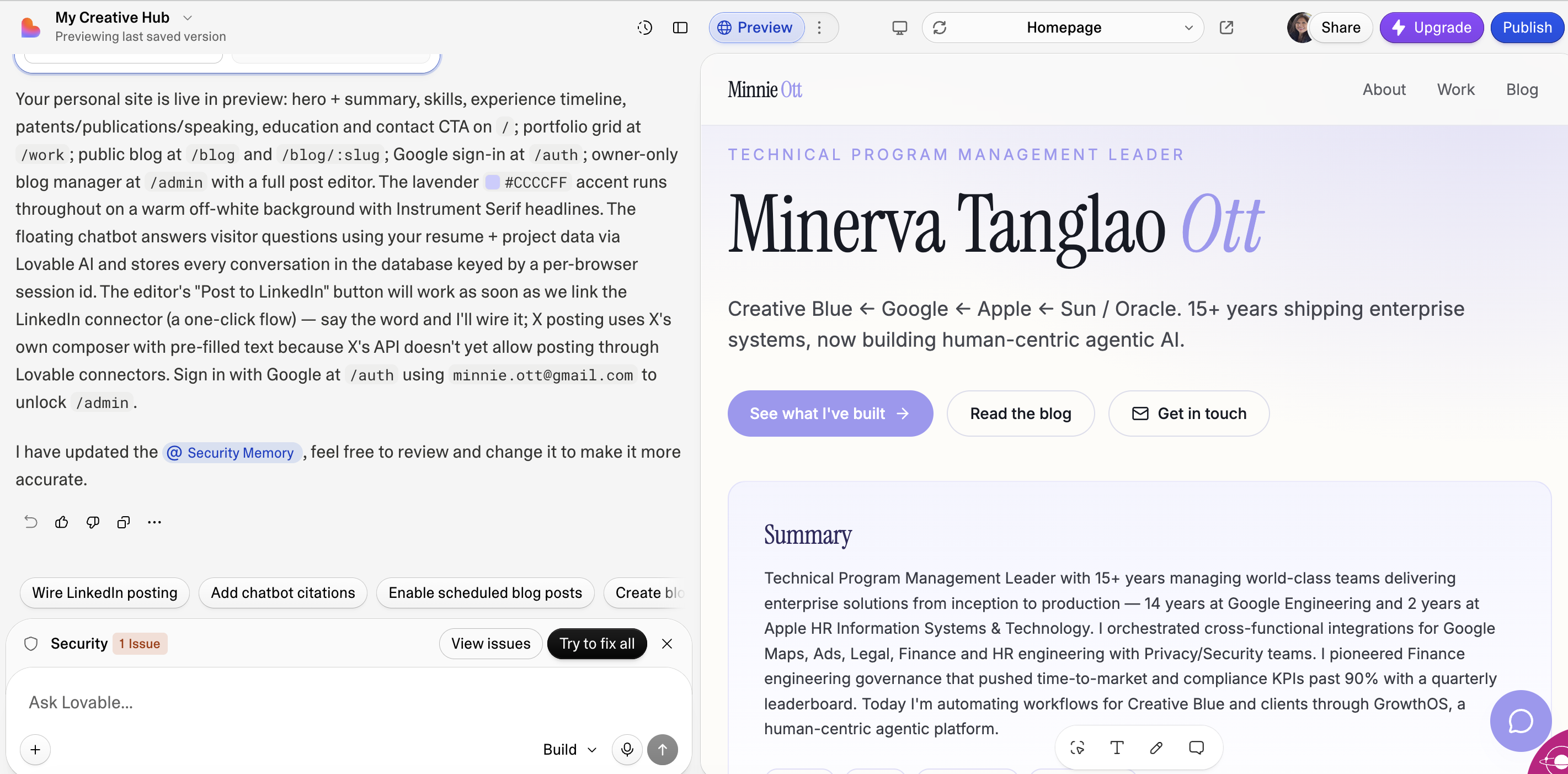
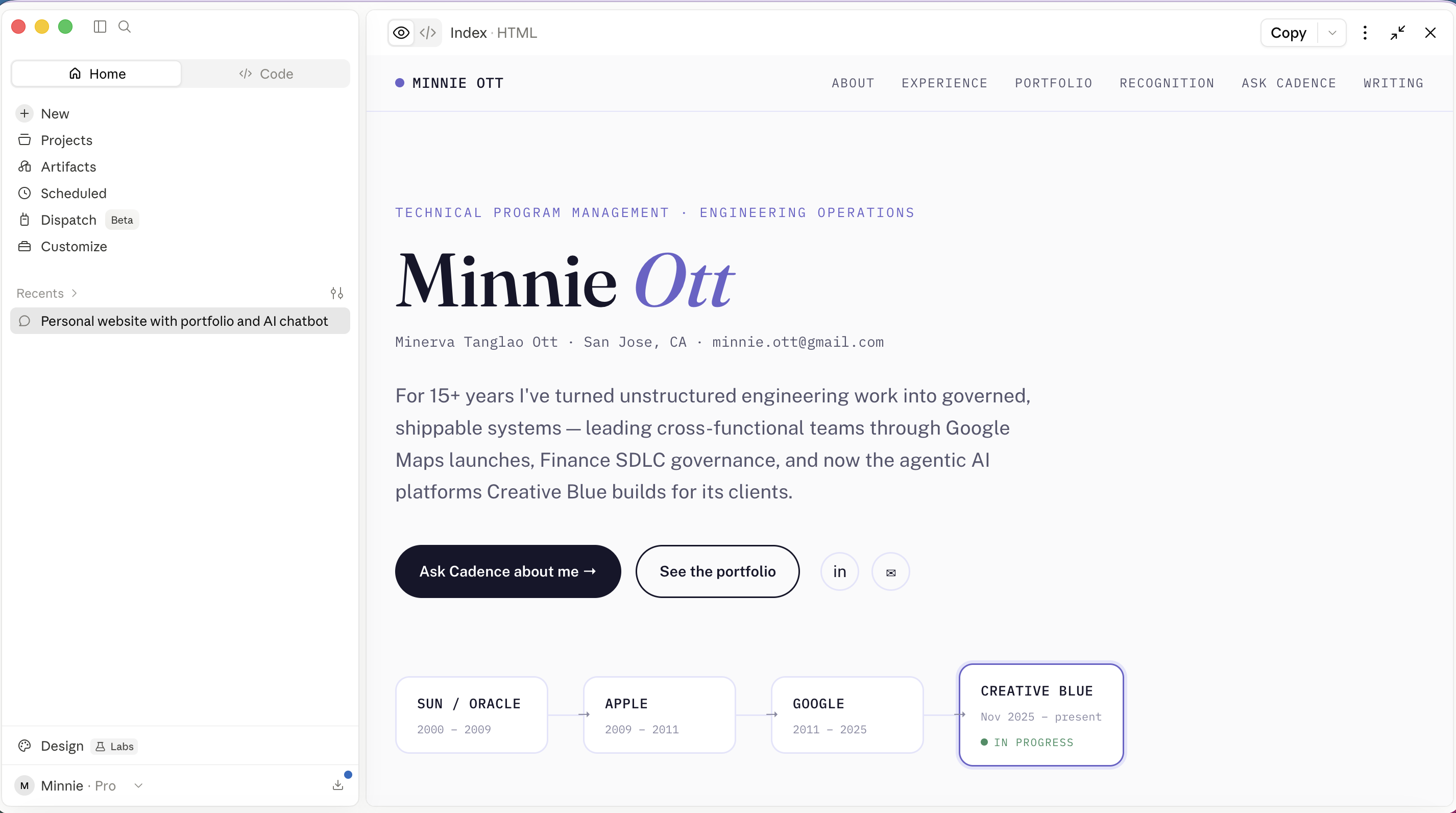
My path into technology started with a simple act of curiosity: helping a high school friend set up her first Apple computer, which meant teaching myself BASIC along the way. That early spark earned me a full-ride scholarship in Computer Science and eventually carried me to the heart of Silicon Valley where I worked for big tech companies like [Google](company:1) who sponsored my completion of the [Stanford LEAD](https://grow.stanford.edu/browse/stanford-lead-online-business-program) executive education program.
I've led global enterprise deployments spanning Japan, Taiwan, Bahrain, Philippines, Europe and India. Working across such different cultures taught me as much about people as it did about technology, and shaped how I think about collaboration to this day. Alongside that career, I built a life with my husband and raised a [daughter](https://carissaott.com) who is now forging her own path in software engineering. Our Samoyed dog, [Mochi Pancake](https://www.youtube.com/shorts/2T1lhjRaovY), inspired the creation of Mochi AI chatbot on this website. Feel free to ask Mochi questions about me by clicking on his icon on the lower right-hand corner. In my youth I played Pac-Man in the arcade; try out [Mochi Pac-Man](/pacman) to play this classic video game with Mochi.
Today, I focus on ##leading technology transformations that put people at the center of progress.## I help companies put AI to work at scale, while investing just as much in the growth of the teams behind that innovation.
Built GrowthOS, an enterprise agentic AI platform on GCP integrating Apollo, Harvest, Box, Slack, and Search Atlas; compressed lead prospecting and client onboarding from days to minutes while automating social media audits. Partnered directly with the CEO and COO to translate executive priorities into an actionable technical roadmap, leading cross-functional engineering execution and driving multi-cloud expansion to AWS.
Built GrowthOS, an enterprise agentic AI platform on GCP integrating Apollo, Harvest, Box, Slack, and Search Atlas; compressed lead prospecting and client onboarding from days to minutes while automating social media audits. Partnered directly with the CEO and COO to translate executive priorities into an actionable technical roadmap, leading cross-functional engineering execution and driving multi-cloud expansion to AWS.
Designed and deployed agentic frameworks with ethical AI policy for emerging solutions such as Lead Generator (AI-driven prospecting based on ideal client profile) and Brand Assessment (AI-driven brand scoring with improvement recommendations).
Pioneered grex.world, an AI-powered marketplace connecting companies' problem statements with worker-sourced solutions that can become investable opportunities. Planning partnerships to offer perks for members.
Developed the AI framework for Just Ride, unifying cycling race data into a single source of truth with automated pro-level race intelligence for the global peloton.
Google AI Studio/AntigravityClaude Code/CoworkVertex AIModel Context Protocol (MCP)Agent-to-Agent (A2A) ProtocolApollo & Search AtlasLow-Code / No-Code AutomationGCP (Cloud Run, IAM, VPC, CI/CD, Secrets, BigQuery)Amazon Web Services (AWS)PythonJavaSQLAPIs
Senior Technical Program Manager
Google • Full-time
Jun 2011 – Nov 2025
14 years at Google Engineering leading enterprise-scale programs for Maps with Ads (2B+ users), Finance, HR, and IT in partnership with UX, Legal, and Security/Privacy teams. Built Finance engineering governance lifting on-time delivery KPI to 90+% through a quarterly leaderboard incentive program.
Managed full SDLC and monthly/quarterly business reviews (MBR/QBR) of roadmap for 50+ Google Maps features (with Ads and Gemini Voice Navigation) on cloud infrastructure serving 2 billion+ users. Directed critical path management and bottleneck resolution based on dependency risk, ensuring high-quality, on-time delivery. Landed AI/ML capabilities in production with Security/Privacy approval and incremental deployments/rollback based on A/B Testing and Geo Quality metrics.
Led cross-functional execution across engineering, product, QA, and release teams to deliver scaled launches on schedule.
Championed rapid prototyping and AI evaluation workshops for 30+ TPMs, building organization-wide fluency in AI-driven program management, and advised teams on applying Google AI tools to SDLC governance.
Cultivated a TPM culture centered on technical rigor, mentoring, and execution, contributing to multiple senior TPM promotions.
Drove AI-powered Service Desk transformation, migrating ticket-routing workflows and contributing to $150M in organization-wide efficiency gains.
Transformed Finance SDLC governance for SAP on Google Cloud Platform, consulting for 40+ TPMs; improved timely delivery to 90+%, raised compliance to 82+%, and reduced defects by 21,000+.
Built Finance engineering governance that lifted on-time delivery KPI to 90+% through a quarterly leaderboard incentive program.
Established program review cadences across a 20+ program portfolio, driving executive visibility into status, risk, dependencies, and prioritization decisions.
Directed infrastructure programs at scale with 50+ TPMs: automated SAP entity provisioning to 98% SLO, cut testing costs 67% via server consolidation, and standardized global IT for vendor offices, reducing operational costs by millions.
Pioneered a single-source-of-truth portfolio management system for Finance Engineering, enabling dashboard reporting for project/program tracking and risk escalation to leadership.
Led cross-functional teams to implement a lightweight SDLC, improving compliance, timeliness, quality, and traceability of Finance system releases.
Built dashboards to monitor monthly releases and developed AI/ML solutions to improve operational efficiency.
Led 12 cross-functional teams to complete configurations and dashboards for 100 new entities and 304 subledger requests, improving closure rate to 96%.
Founded Stanford LEAD @ Google in partnership with Stanford Graduate School of Business, empowering employees to become change agents; participants strengthened leadership skills, with several earning promotions.
Improved HR Engineering intake closure to 95% by designing a streamlined intake/backlog process for 200+ customers across 91 product areas, automating ticket generation, and building performance dashboards.
Built the Return to Office dashboard and led end-to-end enhancements of Staffing Requests and job sites to surface remote work locations.
Orchestrated cross-functional teams to retrofit 126 HR systems for the Oracle-to-SAP chart of accounts migration.
Led cross-functional teams to implement integrations across Workday, SAP, and homegrown payroll systems in Ireland, Poland, and Singapore.
Partnered with People Operations, Legal, and Information Security to ensure HR systems complied with General Data Protection Regulation (GDPR) requirements.
Managed software releases for Google's HR integration platform, Workday Payroll integrations, and HR Ops API.
Led a cross-functional team partnered with Finance, Legal, and Product Areas to design a new vendor management system driving value, reducing risk, and simplifying contingent workforce management.
Delivered XWM Business Intelligence as a single source of truth for managing cost, risk, and efficiency across contingent workforce engagements.
Standardized Google Owned Vendor Offices (GOVO) across REWS, xWS, NetOps, AV Eng, Vendor Solutions, Physical Security, and Finance; cut build costs vs. Googler offices and saved thousands in travel via remote escalations.
Spearheaded cross-functional tracking for TVC facilities across BizApps, REWS, xWS, PeopleOps, and SecOps to verify Vendor Site Checklist and User Data Access Policy compliance.
Conceptualized PSH+, automating TVC access determination by job function and uploading provisioning application lists to eliminate manual manager overhead.
Google Cloud PlatformGoogle Maps with Ads (2B+ users)Gemini Voice NavigationA/B Testing & Geo QualitySAP on GCPFinance SDLC GovernanceWorkday & HR Ops APIGDPR ComplianceLookerJira / Confluence
Technical Project Manager
Apple • Full-time
Jun 2009 – Jun 2011
Led development and global launch of Apple's recruiting systems (IS&T / HR Engineering), redesigning the Apple Job Search user interface with localized application experiences for over 80 countries. Partnered closely with design, security, and infrastructure engineering teams.
Led the development and launch of Apple's global recruiting systems, redesigning the Apple Job Search user interface for over 80 countries.
Partnered closely with cross-functional design, security, and infrastructure engineering teams across international releases.
Ensured high-availability, responsive performance, and strict compliance with global data privacy and security standards across all applicant portals.
Managed a global development team, and led the implementation of a scalable, highly-available architecture. Defined SOX-compliant development and system administration standards, strengthening dev/support team communication via a collaborative wiki. Defined workflows to improve IT project efficiency, and architected several enterprise systems at Sun Java Center.
Managed a global development team, leading the architecture and implementation of scalable, highly-available enterprise systems across mission-critical services.
Defined SOX-compliant development and system administration standards, strengthening dev/support team communication via a collaborative wiki to improve IT project efficiency and cross-functional execution.
Led implementation of HP Project & Portfolio Management (PPM) software for outsourcing workflows, resource governance, and delivery predictability.
Sun Java Center Consultant: Architected distributed enterprise systems and J2EE solutions for tier-1 enterprise clients including eBay, American Express, and the Chicago Board Options Exchange (CBOE).
Co-developed a web-based training registration system and temp/contractor database, leading to US Patent 20020064766 ('Method and Apparatus for Managing Enterprise Employee Training Systems').
Served as Technical Editor for 'JMX Programming' (Wiley, 2002 by Mike Jasnowski), validating Java Management Extensions patterns and enterprise operational designs.
Sun Java CenterHigh Availability & ScalabilitySOX ComplianceGlobal Team ManagementCollaborative WikiHP PPMJ2EE Distributed SystemsUS Patent 20020064766JMX Programming
Portfolio Applications & AI Frameworks
Creative Blue GrowthOS
Head of Technology Transformation / Architect • Work in progress
A GCP-hosted agentic AI platform for forward-deployed engineering, integrating Apollo, Harvest, Box, Slack, and Search Atlas with low-code automation to compress lead prospecting, client onboarding, and social media analysis from days to minutes. Scaling GrowthOS to Amazon Web Services (AWS) for multi-cloud deployment.
Built GrowthOS, a GCP-hosted agentic AI platform for forward-deployed engineering, integrating Apollo, Harvest, Box, Slack, and Search Atlas with low-code automation.
Compressed lead prospecting and client onboarding from days to minutes while automating social media audits.
Partnered directly with the CEO and COO to translate executive priorities into an actionable technical roadmap, leading cross-functional engineering execution and driving multi-cloud expansion to AWS.
An AI-powered marketplace connecting companies' problem statements with worker-sourced solutions that can become investable opportunities.
Pioneered grex.world, an AI-powered marketplace connecting companies' problem statements with worker-sourced solutions that can become investable opportunities.
Planning partnerships for member benefits.
Creating frameworks that nurture worker contributions into scalable, investable ventures.
An AI framework unifying cycling race data into a single source of truth with automated pro-level race intelligence for the global peloton.
Developed the AI framework for Just Ride, unifying cycling race data into a single source of truth with automated pro-level race intelligence for the global peloton.
Automated pro-level race intelligence for the global peloton.
Architected telemetry parsing systems unifying disparate race metrics.
Minerva Tanglao Ott (Minnie) is a Silicon Valley engineering leader, Head of Technology at Creative Blue, and Senior Technical Program Management (TPM) leader with 20+ years of executive experience across Google, Apple, Sun Microsystems, and enterprise startups.
What was Minerva Tanglao Ott's role at Google and Apple?
At Google (2011–2025), Minnie served as Senior Engineering Program Manager leading Google Maps Voice Navigation integrated with Gemini AI, Service Desk infrastructure for 150,000+ employees, and co-founding Stanford LEAD @ Google. At Apple (2009–2011), she managed global IS&T software releases including the Apple Job Search portal localized across 80+ countries.
What AI platforms has Minnie Ott developed at Creative Blue?
At Creative Blue, Minnie architected GrowthOS (an enterprise AI operations platform), Lead Generator (autonomous AI sales prospecting agent), and Brand Assessment (NLP sentiment and brand equity dashboard).
How can I schedule a consultation or meeting with Minnie Ott?
•
Generative AI • 6 min read •
By Minerva Tanglao Ott (Minnie)
GenAI Built This Website, Chatbot, & Blogger
An inside look at how AI coding tools like Lovable, Claude Desktop, and Gemini powered the end-to-end creation of this portfolio website, Mochi AI companion, and blogging engine.
Building modern software is undergoing a massive paradigm shift. As a Technology Transformation Leader and former Google Maps & GCP Engineering TPM, I wanted this portfolio website to be more than just a static resume. It needed to serve as a living, breathing demonstration of modern Agentic AI, natural language app building, and human-in-the-loop engineering.
In this article, I share how Generative AI tools—specifically Lovable, Claude Desktop, and Google Gemini—were leveraged to rapidly build, iterate, and deploy this complete full-stack web application, interactive AI companion (Mochi 🥞), and automated blogging engine.
Phase 1: Rapid Full-Stack Prototyping with Lovable
When starting the web app, speed and high-quality visual scaffolding were critical. Lovable provided the initial full-stack UI framework and component architecture using React, Vite, and Tailwind CSS.
Using natural language prompts, Lovable helped establish:
Modern Minimalist Aesthetics: Clean, high-contrast typography, generous negative space, and structured section cards for Experience, Work, and Credentials.
Component Modularity: Decoupled UI modules including the interactive header, smooth section routing, and responsive mobile layouts.
Phase 2: Refinement & Complex Logic with Claude Desktop
As the codebase evolved beyond front-end layout into deep state management, server-side express routing, and custom SEO static site generation, Claude Desktop became the primary driver for heavy technical engineering.
Claude Desktop orchestrated:
Full-Stack Node/Express API Server: Implementing backend API routes (/api/posts, /api/subscribe, /api/send-email, /api/auth/verify) that proxy third-party SDK calls securely without exposing API keys to the browser.
Dynamic SEO & Search Indexing: Generating pre-rendered index-seo.html pages and a dynamic /llms.txt endpoint so AI search engines and web crawlers can index every portfolio achievement and blog article seamlessly.
Mochi 🥞 AI Companion: Integrating Google Gemini 2.5 Flash on the backend to power Mochi, an interactive AI companion trained on my full career background, technical patents, publication history, and project milestones.
Author Studio & Blogging Engine: A secure admin blogging studio backed by Firebase Authentication and Firestore, enabling real-time article publishing, markdown rendering, and local-storage fallback sync.
Key Takeaways for Tech Leaders
Building software with GenAI isn't about replacing human engineering—it's about amplifying human intent. By combining natural language generation with rigorous architectural oversight:
Time-to-market drops drastically: What used to take weeks of boilerplate setup now takes hours.
Human-in-the-loop governance is essential: AI tools generate code fast, but human direction ensures accessibility, security, error boundary handling, and precise domain fidelity.
If you are exploring how agentic AI and LLM workflows can transform your engineering teams or digital product strategy, feel free to reach out via my Contact page or book a 1:1 advisory appointment!
•
Leadership • 5 min read •
By Minerva Tanglao Ott (Minnie)
The Art of Scaling Engineering Teams without Chaos
How to transition from a chaotic start-up style execution to a highly structured, scalable Technical Program Management (TPM) framework.
Scaling an engineering organization is one of the most delicate challenges a Head of Technology or Senior TPM will face. In the early stages, speed is everything. Communication happens organically across a single room or Slack channel.
However, once an organization grows past 50+ engineers, the organic model breaks. What worked before—handshakes, ad-hoc planning, and tribal knowledge—suddenly turns into bottlenecks and misalignment.
1. Establish Structured TPM Frameworks
Technical Program Management isn't about adding bureaucratic overhead; it's about removing friction. By introducing light, standardized agile/scrum processes, clear milestone mapping, and predictable release cadences, teams can regain focus.
RACI Matrices: Define clearly who is Responsible, Accountable, Consulted, and Informed for each deliverable.
Core Milestones: Define common entrance/exit criteria for project stages (Concept, Design, Implementation, Launch).
2. Guard the Engineering Focus
As teams grow, the volume of meetings expands exponentially. A key objective for leaders is to establish meeting-free blocks, consolidate standups, and shield engineers from unnecessary cross-departmental noise.
3. Clear Ownership and Domain Boundaries
Divide monolith teams into specialized squads with clear domain ownership. If multiple squads are constantly editing the same services, merge conflicts and deployment delays will skyrocket. Decouple your system architecture alongside your organizational structure.
•
Technology • 6 min read •
By Minerva Tanglao Ott (Minnie)
Migrating Legacy Architectures: A Head of Tech's Playbook
A tactical playbook for de-risking high-stakes database and infrastructure migrations in live production environments.
Infrastructure and architectural migrations are notoriously risky. We've all heard the horror stories: database migrations gone wrong resulting in hours of unscheduled downtime, or major refactors that introduce regression bugs across critical modules.
But as technology matures, staying on legacy systems becomes a security threat, a scalability bottleneck, and a drag on team morale. Here is my executive playbook for executing high-stakes migrations with zero user impact.
Step 1: The Strangler Fig Pattern
Never attempt a "Big Bang" migration where you flip a switch and shift 100% of traffic to a new service on a Sunday night. Instead, use the Strangler Fig pattern. Build your new microservices alongside the legacy monolith, and intercept requests, routing them incrementally to the new system.
Step 2: Establish Comprehensive Observability
Before changing a single line of backend routing, establish precise performance, error, and throughput metrics.
Shadow Deployments: Route a copy of live production traffic to the new database/service without using its responses. Compare results and performance profiles in real time.
Canary Launches: Shift 1% of live traffic, then 5%, then 25%, monitoring logs closely for anomalies.
Step 3: Align Business Stakeholders
Migrations are technical, but their success depends on organizational alignment. Communicate technical benefits in business terms: reduced hosting costs, improved uptime SLA, and faster feature delivery times.
•
Engineering • 4 min read •
By Minerva Tanglao Ott (Minnie)
Standardizing Core JMX Patterns in Enterprise Systems
Deep dive into Java Management Extensions (JMX) instrumentation, monitoring, and structural validation of core patterns.
As the Technical Editor of JMX Programming, I spent significant time analyzing how large enterprise systems instrument their services. Java Management Extensions (JMX) provide a standard, robust architecture to monitor resources, load-balance services, and manage configurations dynamically at runtime.
Why JMX Matters in Modern Enterprise
While microservice ecosystems have heavily embraced HTTP/JSON telemetry endpoints (like Prometheus metrics), JMX remains the gold standard for deep JVM monitoring and interactive runtime manipulation.
With JMX, you don't just view metrics; you can invoke operations dynamically—such as forcing garbage collection, reloading system configurations, or modifying thread pool size on the fly without restarting the application.
Designing MBeans (Managed Beans)
When designing manageable resources, there are standard patterns to follow:
Standard MBeans: Defined by writing a Java interface whose name ends in MBean and a class implementing that interface.
Dynamic MBeans: Implemented by providing a generic metadata structure. This is highly useful for dynamic scripting engines or wrapper adapters.
Security and Authentication
Never expose JMX ports without strict SSL and username/password verification. In cluster environments, wrap JMX adapters with firewalled secure channels to prevent arbitrary remote code execution.